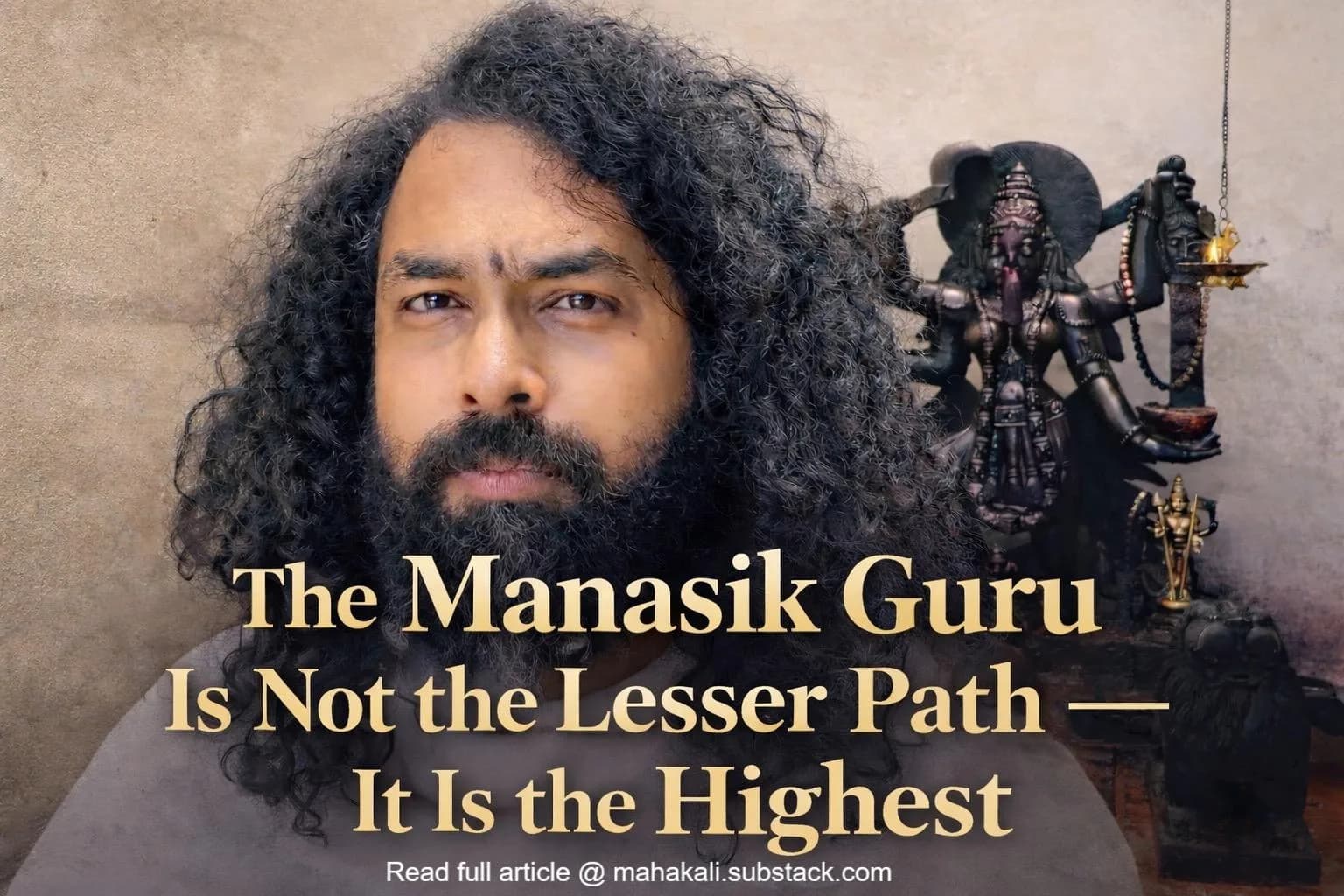
Two kinds of Guru stood at Kurukshetra. The answer to 'how do I become a shishya' is drawn from the contrast between Dronacharya and Shri Krishna — and it is simpler than expected.
After Praveen Ji’s Delhi satsang, a flood of messages and emails arrived — all circling the same question: How do I become a shishya? How do I formally become the disciple of a guru? It came up so many times — in person, over message, over email — that it deserved a complete answer. That answer, as laid out in this talk, is drawn from the wisdom of the Mahabharata and from the contrast between two of its most extraordinary guru figures: Guru Dronacharya and Shri Krishna.
Krishna, Kali, and the Pain of Kurukshetra
Before entering the guru-shishya question directly, an important theological foundation is laid. Shri Krishna is not separate from Maa Kali. The 36th name of Kali is Krishna, and the 37th refers to Krishna’s very form and body. For those who have not yet come into alignment with Maa Kali, this may seem like a surface-level observation about the word “dark.” But for the Kali sadhaka, there comes a state of understanding that when Krishna walked the earth, it was not merely a man walking — it was Mahakala, time itself, moving. Every second, time was being consumed as Krishna walked.
This matters for how we understand Kurukshetra. When Shri Krishna speaks to Gandhari, he makes clear that he did not watch the war as a spectator from a distance. Every arrow, every drop of blood on that ground, every mother who lost a son, every wife who lost a husband, every child who lost a father — that pain was Krishna himself. His message: I am not separate from this suffering. I am the pain. He won nothing at Kurukshetra. He gave the lessons, absorbed the grief, and moved on. That is the nature of the one who is Maa Kali — not a detached observer, but the very substance of all that unfolds.
It is from this ground — Krishna as Kali, as time, as the all-pervading — that his role as the Manasik Guru ( Mentally Accepted Guru) must be understood.
Two Kinds of Guru: Drona and Krishna
By every conventional measure, Guru Dronacharya was the highest kind of guru — perfect, sincere, extremely powerful, highly blessed. His tapasya was immense, his knowledge unmatched. He followed every vidhi, every diksha ritual, every norm of the parampara. His personal shakti alone could have changed the course of the Kurukshetra war.
And yet, there is something deeply instructive in how Drona dispensed his greatest blessings. All of his highest tapasya — the most powerful kavach he could offer — was channeled by birth into his own son, Ashwatthama. This protection shielded him from famine, dark forces, misfortune, and more. The shishyas — Arjuna, Yudhishthira, Duryodhana, Karna — all received his teaching equally. But the highest grace flowed through blood.
There is a further complication. Guru Drona, despite his immense dharmic power, ultimately tilted toward the Kauravas — not because they were more righteous, but because they held the throne, the wealth, and the political power. The Pandavas had dharma on their side. The Kauravas had kingdom. Within the rigid framework of vidhi and parampara, both sides sat at the same level before the guru.
This is the essential trap of rule-bound discipleship in Kali Yuga. When you seek a guru purely through established ritual and parampara, you enter a system that can be gamed. A “foxy” person with money, political clout, and persuasive charm can present themselves convincingly and receive the same diksha as a genuinely sincere sadhaka. Dharma and adharma, in that framework, end up treated as equals.
This is not merely an ancient problem. At the recent Mahakumbh itself, many people were dressed as realized sadhakas, presented themselves as chosen ones with compelling stories, and drew large followings — but had no genuine depth. Their very jattas were not original but artificially fixed. The outward appearance of realization is exactly what Guru Drona’s framework, however powerful, ultimately cannot filter out. By the rules of vidhi and parampara alone, the influencer and the sincere sadhaka stand in the same line.
Enter the Manasik Guru
Now enter Shri Krishna — wearing no robes, carrying no weapons on the battlefield, claiming no formal role as anyone’s guru. He is simply Arjuna’s charioteer.
Notice what Krishna does not do. He does not pass the Gita to his own sons. They could have received this highest knowledge from him. But he does not choose his own bloodline as the recipient of this divine sanction of knowledge. He gives it to Arjuna — someone not born of him. Virtue, not birth. This is the direct counter-statement to the entire Drona-Ashwatthama dynamic. Those who claim superiority by birth — “we are from this parampara, we are from this caste, we are born into this lineage” — are operating from the Drona framework, which has already collapsed in Kali Yuga. What remains standing is virtue alone.
The pivotal moment arrives when Arjuna asks Krishna to drive the chariot to the center of the battlefield. Nobody stops them. Nobody objects. And in that charged stillness, something begins — not as a formal teaching ceremony, not as a diksha ritual, but as a direct inner conversation. Praveen Ji explains that the entire Bhagavad Gita is a manasic conversation. It happens within. It is not a public lecture delivered to a group. It is one guru speaking into the atma of one shishya.
Arjuna had long considered Dronacharya his guru. That identity was fixed in him. But at Kurukshetra, that certainty crumbled — because it was not Drona who rose to give him the upadesh of how to live. It was the man standing right next to him, the one he had overlooked as a mere charioteer.
The Kauravas, confident in their possession of the greatest guru Drona, took his entire arsenal — the Narayani Sena, all the shastra knowledge, every prayoga. Krishna, meanwhile, arrived without his army, without weapons, without any outward display of power. He took nothing from the conventional system. And still, through pure manasik presence, he guided the Pandavas to victory.
What About Drona’s Kavach on Ashwatthama?
Guru Praveen Ji reveals that there is one more remarkable layer to this teaching, and it speaks directly to the gurus of Kali Yuga, not just to seekers.
Even the great kavach — that supreme protection Guru Drona had embedded into Ashwatthama through a lifetime of tapasya — was not permanent. Shri Krishna, as the master of life itself, as the one who had transcended all fixed forms and rigid methods, ensured that this kavach was taken from Ashwatthama and passed to Draupadi, who then offered it to Yudhishthira — the one who upheld dharma the highest.
Grace is not a fixed inheritance. It moves. It flows toward sincere sadhana and toward dharma, regardless of bloodline, birth, or formal ritual standing. The guru who places his entire tapasya as a shield over his own child, imagining it permanent, will find that a higher realized being can realign that grace entirely — and direct it to the sincere, virtuous shishya.
This is a living message for contemporary gurus: no matter how powerful the tapasya, the moment one falls prey to the designs of Kali Yuga — favoring by birth, by money, by appearance — that accumulated grace can be redirected. It will go to whoever holds dharma the highest.
So How Do You Become a Shishya?
After laying all of this out, the direct answer arrives — and it is simpler than expected.
You already are one.
The very desire that brought you to seek — the sincere pull toward a guru, the genuine longing for gyaana — that quest itself has already established the relationship. The connection to the Manasik Guru is not established by a ceremony, a ritual, a list of offerings, or by sitting at someone’s feet in an ashram. It is established by the sincerity of your own inner orientation.
In Kali Yuga, the deity takes the form of that which you have associated it with. If you come to a Guru sincerely seeking knowledge of the divine, the nirakara — the formless — takes the shape you have associated with it, and communicates through that form directly to your asana, your dreams, your moments of awakening. The deity is already operating within the limited outer form of the guru, and it makes itself unlimited inside you. That is the vishwarupa darshan happening within.
What obstructs this? Only doubt. Arjuna, at Kurukshetra, did not sit in the middle of two armies and second-guess whether the gyaana he was receiving was real. He surrendered completely. That complete surrender — letting go of the impulse to control or verify the experience — is what allows the manasik transmission to happen.
What Is Actually Required
Praveen Ji is direct about what the path does and does not ask of you.
The path does not ask you to sit in an ashrama. It does not require costly rituals or elaborate prayogas. It does not require physical proximity to any Guru. What it does require is sincere sadhana — every day, in your own asana — and an unwavering shraddha that the guru and the ishta will appear within that space. A minimum of a thousand days of sincere, committed sadhana is the baseline for this inner establishment to take root.
In Kali Yuga, nama japa, the Manasik Guru, and intense surrender to the deity are sufficient. These are not lesser tools. The Manasik Guru is not an inferior or second-best arrangement — it is the highest state. It is Krishna giving the Vishwarupa darshan within the atma of Arjuna. It is the divine operating through the inner world rather than the outer one.